


































| | |
|
| |

Comic Con hadn't even started (T minus 5, 4, 3...hours to Preview Night), and already, people behind the scenes were feeling the heat.
This goes out to all the people, young and old, who stuff those gift bags, maintain crowd control, and take those Starbucks orders for mocha venti frappucinos with whipped cream and sprinkles.
Exhibit A--The young man behind the Exhibitor registration counter at 12 pm:
"Wait, what company are you from?" he said and swayed.
We gave him the information and noticed him staring into space at some faraway point above his laptop computer.
"Wait, what was your name again?" he said and tilted. We watch with horror as his eyes flickered and start to roll towards the back of his head.
"Are you okay??" we asked him.
"Oh, y-yeah," he said, righting himself back up. "I just...I just haven't...had l-lunch today yet," he finished faintly.
Exhibit B - The guy regulating a line outside the convention center at 2 pm:
"Hey! What's this line for?" I asked him.
"Oh, this line is for the pro registrants," he said. "And this line is for the...ex...exhib...exhibitionists."
I smile at him.
"Wait, no," he shakes his head. "I've been saying this so much all day, sorry about that."
"Exhibitors?" I say.
"Yes, that's it," he says.
"Did you have lunch?' I ask.
"Uh, you know, now that you mention it..." he says.
A few days ago, I discovered via friends’ links that the George Eastman House had uploaded a large number of very old photographs to Flickr. Since then, I’ve been browsing through them, looking up the people who are named, and puzzling over the anonymous, sometimes moving, sometimes creepy, images. There are stories here. And some surprising old friends: There’s an actual photograph of Princess Marie of Romania!
This is a photograph of Louis Jean Lumière. Lumière was a cinema pioneer – he invented one of the earliest motion picture cameras, and produced and directed the very first movies ever shown to the public. But he also invented the still photography process known as Autochrome, an emulsion technique that produced color photography. The George Eastman House photos include 68 early autochromes, and they fascinate me even more than the 19th century black and whites.
There’s something about this one….called only “Woman in a Floral Silk Robe”.
It was made in 1915, by a photographer named Charles Spaeth. Beyond that, we know nothing of who this young woman was, where she lived, what she was thinking to create this sly, mischievous pose. Most of the other photos in the set are formal sittings, or still lives. This is an intimate portrait.
Take a look at the collection. It’s a remarkable resource, made available on the internet without restrictions, for our enjoyment. You’ll find some stories there.
All photographs from the George Eastman House collection are made available under a creative commons license. Details here.
After a day of travel, Tor.com is reconstituting itself in San Diego, much like transformer-style robots that reassemble into Irene Gallo, Liz Gorinsky, Pablo Defendini, David Moldawer, Faith Cheltenham, Carey Tse, Jim Frenkel, Eric Raab, Brian Vaughan, Dot Lin, Patty Garcia, and me. Okay, not actually much like that. This morning we're setting up the booth we share with Tor-Books-the-publisher and manga publisher (and Tor distribution client) Seven Seas. Over the next several days we'll be extensively blogging the vast "geek prom," but before we got started, I couldn't resist taking a few shots of the event under construction.

Below, the view directly across from us. Uh oh.
Soon, we may well all live on peripatetic pond-fodder, lazily riding the currents from sea to sea to sea. Vincent Callebut is a Belgian architect with a penchant for grandiose post-apocalyptical thinking. His ‘Lilypad Floating Ecopolis’ (pictured here) is a self sustaining, amphibious structure which houses approximately 50,000 people. Its design was inspired by the prospect of having to house coastal refugees after the polar ice-caps have all melted away. Take a look at his website, which, along with the Lilypad, serves as showcase for two other concept projects, both equally SFnal: The ‘Anti-Smog’ of Paris and the ‘Perfumed Jungle’ of Hong Kong. If nothing else, the beautiful renderings will hold your imagination hostage for quite a while. (Via CNN.)

A quick show-and-tell.
Here are Dan Dos Santos' sketches and final art for Jay Lake’s Green -- an upcoming novel based on his short story of the same name.
I was with Dan at a convention when he was bemoaning how busy his schedule was and how he didn’t have time off for months and months. As soon as he finished I said, “We have a book about a gorgeous, deadly, assassin girl.” Suddenly he had an open spot.
I have a late night confession to make:
I’m a pirate. A bloody, stinkin’, thieving, baby-killing, livelihood-destroying, profit-sucking file-sharer.
There, I said it. If I don’t make it to Comic Con, look for me under the massive pile of DMCA notices.
I download mostly TV shows using a combination of BitTorrent and RSS feeds reliably and (seemingly) effortlessly, and I watch what I want, when I want. I regularly turn my friends onto good, new television shows by handing them a DVD and saying “Go. Watch. Enjoy. You’ll thank me later.” (boy, Battlestar Galactica’s been a good one for that).
Why do I go through all the trouble, and run the risk, if I could simply be content with a cable subscription and be done with it? I think it's fair to say that there are legal alternatives out there for those that want to enjoy TV programming ‘on-demand’, but these solutions are not entirely adequate--at least for me--for various reasons. Let's look at the usual suspects:
[read more, arr arr]
Once upon a time I was a book reviewer for Publishers Weekly. Although my name wasn't on the reviews, the fact that they appeared in PW made me one of the most influential SF/fantasy reviewers in the world. I wasn't a big fan of the weekly deadlines, but I did have lots of fun getting the first word in on a wide variety of important SF and fantasy. One of the side effects was that I was as au courant with the field as I've ever been, and probably ever will be.
That meant that when Hugo nomination time came around, I already knew what I wanted to nominate; and when it was time to vote, I'd already read all the nominees.
Nowadays, being busy trying to find and publish future Hugo winners of my own, I just can't keep up. Every year this century I've sworn I would take a week off and read all the nominees -- the ceremony is much more fun if you've voted and have a rooting interest -- and every year I haven't managed it. (To my mind, people who vote without reading the nominees are beneath contempt.)
This year was no exception.
So I'm going to take advantage of the shiny new soap box provided by Tor.com to find out what I've been missing.
Here's a list of the Hugo nominees for best novel:
* The Yiddish Policemen's Union by Michael Chabon (HarperCollins; Fourth Estate)
* Brasyl by Ian McDonald (Gollancz; Pyr)
* Rollback by Robert J. Sawyer (Tor; Analog Oct. 2006-Jan./Feb. 2007)
* The Last Colony by John Scalzi (Tor)
* Halting State by Charles Stross (Ace)
The only one of these I've read is Michael Chabon's book, which I loved (and which, to my pleasant surprise, won the Nebula). So I'd like you to tell me which one you think should win (and why) and which one you think will win. (Alas, you can't influence my uncast vote, since the voting deadline was back on July 7th.)
I'm sure the results will be enlightening, and I look forward to seeing what you have to say. (No extra credit for picking a Tor book!)
[2005 Hugo Award image from Wikipedia Commons; reproducible for any purpose.]
Recently, Tor.com user GUDsqrl posed this question in the comments section of a previous post of mine:
"So is paying to publish fiction and trying to recoup at least some of those costs by selling copies shortly going to be dead? Is all short fiction to be free?"
In my opinion, GUDsqrl has a vested interest in this question, as I believe he is part of the team (all of the team?) that publishes GUD, a literary genre fiction journal. I don't know a lot about them, I must confess. They've only had a handful of issues come out so far. They look well designed, and they have some interesting authors, so we'll see what the future holds for them. I'm sure that's at least part of why GUDsqrl asked his question.
This is one of those questions along the lines of how many grains of sand make a pile? It's all based on the interpretation of the individual. Generically speaking, I think short fiction will be around for the long haul. It's too well appreciated by the field to go anywhere. It may radically change, but it will be around.
For the purpose of this post, let's discuss some different levels of print magazines and how they work or don't work.
[more after the cut...]
Did a massive underwater volcanic explosion create the oil we're now sucking out of the crust of the planet at ruinous rates? Possibly: Researchers at the University of Alberta hypothesize that such an explosion 93 million years ago first created a massive bloom of life as the volcano belched nutrients into the water, and then, as this smorgasbord depleted, the massive ensuing die-off depleted the oxygen in the ocean, allowing the dead organic matter to settle rather than decompose normally, as it would in an oxygen-rich environment. And then there it was: the black sludge that is the tweaky crank goodness our civilization runs on.
The good news here is now we know how to replenish our oil reserves: crack the skin of the planet, let an entire food chain of creatures feast on the minerals and then catastrophically die off, and then just wait several million years. It's just that easy!
[Oil well image by FLcelloguy, licensed under the Gnu Free Documentation License, Version 1.2; details on Wikipedia.]
Terry Karney let me know of the existence of Tin Eye; an image search engine with a difference. This one doesn't search for pictures of kittens; you give it a picture, and it finds copies of that picture. The copies can be found even if they've been rotated, used in a collage, and so on.
The site is in beta, and they point out that they've only indexed a fraction of the images on the net. Nevertheless, I found that art and photography of mine is being used without credit all over the place. Obviously I knew that was likely to be the case, but here is the rub; I'm an indifferent photographer and my art is highly specialised. My guess is that if your art and photos are more usable than mine, they'll be nicked more.
Some of the uses don't trouble me; if you want to crop a picture of mine for an 100 pixel icon, I can live with that, though I'd like a credit. But whole pictures, large resolution, with no credit and a new watermark? Selling a photo of mine as a t-shirt? Putting photos of my kids in a reel of funny photos? I found all of those through Tin Eye, and I'm not sure I want information to be quite that free.
Anyway, it struck me that quite a lot of you might also be interested to find out who's using your stuff too. It's a private beta at the moment, but I emailed them and requested an invite, and got one within hours.
I mentioned in my post on Vinge's A Deepness in the Sky that I don't believe the Singularity is a problem. Commenters Dripgrind and Coveysd asked about that, and I decided the answer was worth a post.
Vinge came up with the Singularity in Marooned in Realtime (Analog, May-August 1986; Bluejay, 1986), which I read in 1987 when it came out in Britain. I thought then that the Singularity was a terrific SF idea--the idea was that technological progress would spiral so fast that something incomprehensible would happen. In the book, most of humanity has disappeared, and the plot concerns the people who missed it. (Incidental on-topic aside--the reason I re-read Marooned in Realtime is for the journal of one of the people who missed it. The plot, the ideas, the other characters have all worn fairly thin over time, but Marta's journal as she lives alone on a far-future Earth remains compelling.) I was astonished at reaching the end of the book to discover a little afterword in which Vinge claimed to believe in the coming Singularity. I thought it was a great idea for a story, maybe even two or three stories, but too obviously silly for anyone to really believe.
Since then, the Singularity has come to be an object of almost religious faith in some quarters. In The Cassini Division, Ken MacLeod has a character call it "the Rapture for nerds," and that's just how I see it.
I understand how Vinge, a brilliant writer who had worked in computing for years, could, in 1986, have seen how incredibly quickly computers had developed, and extrapolated that to other things. I mean it's like someone seeing in 1950 that a hundred years before the fastest speed was twenty miles per hour and now it was supersonic and extrapolating that line straight forward to having FTL by 1983. Nevertheless, I regard this as a kooky belief. Yes, in 1950 we were supersonic, and gosh, we're in 2008 and...we're still traveling in jets only very slightly faster than in 1950, and cars, and subways, and buses. Even computers are only incrementally better than they were in 1987, and this isn't entirely because they're mostly handicapped with Windows. I'm not saying they haven't improved. I'm just saying that if we'd carried on the extrapolated curve between 1950 and 1987 we'd have something a lot better. Instead, we got the internet, which is a lot better, which is a new thing. That's what people do. They come up with new things, the new things improve, they have a kind of plateau. It doesn't go on forever. A microwave is shiny and science fictional but a toaster makes better toast, and most people have both, and few people have much in their kitchen that's much newer. And people are still people, traveling fast, using the net, and though they may go through paradigm shifts, I don't think we'll ever get to the point where understanding the future would be like explaining Worldcon to a goldfish, and even if we did, it wouldn't be very interesting. If you want to argue about how much closer to the Singularity we are than we were in 1987, fine, but I'd suggest taking a look at The Shock of the Old: Technology in Global History Since 1900 by David Edgerton first. But my view remains, nice SF idea, not going to happen.
I wouldn't care at all about people believing in the Singularity, any more than I care about them believing in the Great Pumpkin, if it wasn't doing harm to SF for everyone to be tiptoeing around it all the time.
What irritates the heck out of me is that so many other people have come to have faith in this, despite zero evidence, and that this is inhibiting SF. It's a lovely science fiction idea, and so are Gethenians, but I don't see people going around solemnly declaring that we must all believe there's a planet out there with people who only have gender once a month and therefore nobody should write SF about gendered species anymore because of the Gethenian Problem. Yet somehow the Singularity resonated to the point where Charlie Stross called it "the turd in the punchbowl" of writing about the future, and most SF being written now has to call itself "post-Singularity" and try to write about people who are by definition beyond our comprehension, or explain why there hasn't been a Singularity. This hasn't been a problem for Vinge himself, who has produced at least two masterpieces under this constraint. But a lot of other people now seem to be afraid to write the kind of SF that I like best, the kind with aliens and spaceships and planets and more tech than we have but not unimaginable incomprehensible tech. (Think Citizen of the Galaxy or pretty much anything by C.J. Cherryh.) I recently asked about this kind of SF in my LiveJournal and only got one recommendation for something I wasn't already reading. Maybe it's just a fashion, but I blame the Singularity--and that, to me, is the Singularity Problem.
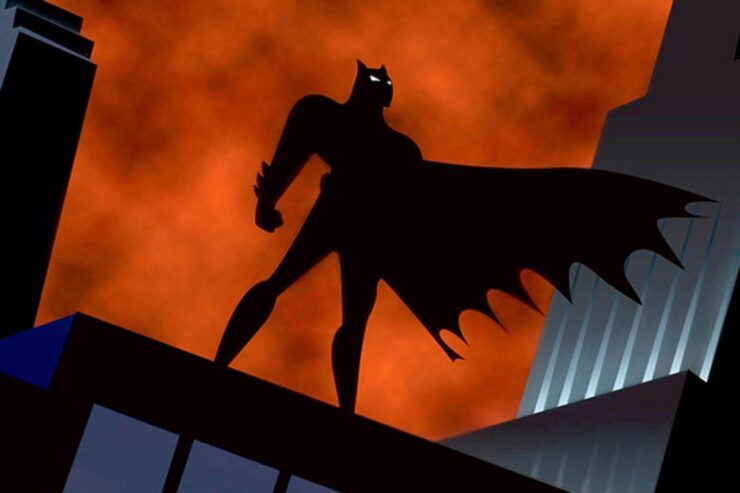
Over the weekend I blogged about PETA's list of the Top 10 Animal-Friendly Superheroes. Via an update on CWR, I see that PETA has kicked Batman off the island because of his dog combat in The Dark Knight. (Hellboy replaces him.) PETA Dudes. I have two words for you: Self. Defense.
By the by, I read somewhere people saying that Batman tossed one of the dogs out the window during the big skyscraper fight. I didn't see it that way, and I was kind of alert for the possibility of a dog getting pitched. In my experience, an American movie will show you almost any kind of atrocity against human beings, but will scrupulously avoid graphic despoliation of Fluffy. My recollection is that, in Shooter, where the Feds' murder of the protagonist's dog becomes a major motivation, the movie keeps the dog's death safely offscreen. Am I misremembering either or both of these movies?
Meanwhile, the weekend is over, and I'd like to open this thread to completely spoilerous discussion of the movie.
This is not exactly related to science, but on the other hand, not entirely sure which other blogger here would handle it, so:
Yearning for a pedicure but tired of the usual emery boards and flensing razors? Why not let tiny fish devour your toe flesh instead?
Fish pedicures are creating something of a splash in the Washington D.C. area, where a northern Virginia spa has been offering them for the past four months. John Ho, who runs the Yvonne Hair and Nails salon with his wife, Yvonne Le, said 5,000 people have taken the plunge so far.
"This is a good treatment for everyone who likes to have nice feet," Ho said.
Apparently you put your tootsies in the water and the fish come up and start snacking on your dead skin. They leave your live skin alone because they don't have teeth, and therefore cannot strip your feet to the bone like they want to.
<Simpson Reference> Because, make no mistake, Timmy. If given half a chance, these tiny fish would kill you and everyone you know. </Simpson Reference>
There's a picture of the fish in action at the article if you want to squick yourself out.
I've never had the urge for a pedicure (living the soft, easy life of a writer I have no feet calluses to speak of, which means I win), but if I did, I don't think allowing vertebrates to consume portions of my body while I am still alive is the way I would want to go about it. Call me an atavist.
The article mentions that the fish treatment has been so successful that the spa owner wants to offer a full body treatment using the fish. Hey, you first, pal.
(Picture above by Terry Goss, used under CC license. Knicked from here)
The platypus has always impressed me as something kludged together from a box of spare parts and assembled by committee. It’s the weirdest creature you can imagine. It’s warm-blooded and has fur, but the females lay and incubate eggs—and then produce milk to feed their young, which are developmentally incomplete when they hatch. It has what looks for all the world like a duck’s beak, an electromagnetic sensing system, and (in the male) venomous spurs on the hind legs. It doesn’t have teeth (as an adult) or visible ears.
So, is it a mammal? A marsupial? Both? Neither? And how do you explain that beak?
A couple of months ago, a consortium of scientists from all over the world—the Australia (but of course) England, Germany, Israel, Japan, New Zealand (duh), Spain, and the US—announced that they had sequenced the platypus genome.
And it’s just as weird as you might expect. The platypus’s genes look like something ordered from an old-fashioned Chinese restaurant menu—one from Column A, two from Column B.
The conclusion to the paper in Nature, "Genome analysis of the platypus reveals unique signatures of evolution,” says, among other things, “Of particular interest are families of genes involved in biology that links monotremes to reptiles, such as egg-laying, vision and envenomation, as well as mammal-specific characters such as lactation, characters shared with marsupials such as antibacterial proteins, and platypus-specific characters such as venom delivery and underwater foraging.”
In other words, the platypus looks like what it is: a mammal with reptilian/avian and marsupial characteristics.
While this should not have been a surprise, somehow, it was—to me at least. When I read of the announcement in the news (the NIH press release), I went around grinning for days. A piece of the universe had just clicked into place and the world had become a little brighter and more fun.
The platypus is put together from a strange set of instructions. Knowing that makes me happy.
[Platypus photo by striatic, licensed under Creative Commons Attribution ShareAlike 2.0, and found on Wikimedia Commons.]
A couple of years ago I decided I needed to be playing more video games, and picked up the just-released Nintendo DS Lite. I played with it intermittently, finished all of the Sudoku levels on Brain Age, but it wasn’t till I got Anno 1701 (sort of a cross between Sim City and Sid Meier’s Civilization) that I really got hooked on a game. (No, I haven’t yet picked up the recently released actual Sid Meier’s Civilization DS game.) That got me carrying my DS around with me all the time, which in turn got me looking for other interesting things I could do with it. Which gets you this column about world of DS homebrew — games written by hobbyists, outside of the official Nintendo-approved distribution channel. Instead of being released on cartridges (“carts”, in gamer parlance), these are released on the net as downloadable software. To use them, you need some kind of cart-like system with user-accessible storage, generally called a flash cart.
The market has provided, and how. Nintendo has sold over 70 million DS and DS Lite systems, and since flash carts can be used to load pirated commercial games, the market for such devices is very active, especially in South Korea. The demand for flash carts is high enough that the most popular brand has attracted its own market for counterfeit units. Welcome to the brave new global marketplace.
But enough about the pirates; I’m here to talk about legit uses. DS Fanboy reviewed some of the more popular flash carts a few months back, which should help winnow down the bewildering variety of choices. They’ve also got a glossary to help you parse the hobby jargon. I got a CycloDS Evolution with a 2-gig microSD card. Two gigs ought to be more than enough for games, but you might want more storage if you’re going to use your DS as a music or video player (about which see below). On to the games (and other programs):
[more below the fold]
No, not that KGB, this one. The KGB Bar is a small, out-of-the-way bar in New York's East Village that hosts all manner of literary readings and events. It's been doing so since 1993. Pertinent to our discussions here, the bar has been hosting a Fantastic Fiction reading the third Wednesday of the month since the late 1990s.
What type of people do they get to read there? This is just a sampling:
Joyce Carol Oates, Lucius Shepard, Jeffrey Ford, Scott Westerfeld, Kelly Link, China Miéville, Nancy Kress, Jack McDevitt, Stewart O’Nan, James Patrick Kelly, Barry N. Marlzberg, Samuel (Chip) Delany, Holly Black, Michael Swanwick, Kit Reed, Peter Straub, Andy Duncan, Richard Bowes, Catherynne Valente, Ellen Kushner, Jeff VanderMeer, Naomi Novik, Elizabeth Bear, and many more.
If you live on the east coast, you should make the trip to New York on the third Wednesday of the month to attend a reading. I was in Philadelphia this past January, and I made sure to add a few more days to my trip so I could go to a reading. I even helped set up who was going to read by soliciting authors from the Electric Velocipede backlist.
Readings start at 7, get there early if you want a seat. It's worth the effort. When I lived out east, I tried to make it every month. I missed more than I went, (once I learned the reading series even existed) but I was ALWAYS glad I went. It's one of the things I really miss from out East.
Now, if you don't live (like I no longer do) on the East Coast--heck many of you don't even live in the States--I'm probably just irritating you by talking about how awesome this is. But there's a reason for bringing this up.
[More below the fold...]
In the category of things we already knew but it's interesting to have scientific proof for: (Young) men respond hormonally to (young) women almost immediately -- even ones they aren't particularly interested in:
Research involving a group of male students found that their levels of the hormone testosterone increased to the same extent whether they were talking to a young woman they found attractive – or to one they didn't fancy much at all.
After 300 seconds alone in the same room as a woman they had never met before, and in some cases did not find particularly attractive, the men's testosterone levels of the hormone had shot up by an average of around eight per cent.
The study's authors believe the rise in testosterone may be an automatic and unconscious reaction that has evolved in man when faced with a woman, to prepare him for possible mating opportunities.
Essentially, this is why you so very infrequently hear young men say "not if she were the last woman on Earth." Their minds are made up on that score even before the men know their minds are made up.
Mind you, this is one of those studies determined to create more questions than it answers. My questions: Do young women have the same sort of immediate hormonal response (and if so, is it triggered by the men attempting to act more "manly" as hormones steep through their systems)? Do gay men have the same hormonal response to women as straight men and/or do they have the same hormonal response to men and straight men do to women? And also, how long before some opportunistic lawyer tries to argue in front of a jury that a flush of hormones made his client attempt something stupid and criminal against a woman? Because you know one will. Grumble.
Being a guy, the finding of this study makes sense to me; I do notice that my internal reaction to meeting a new woman is ever-so-slightly different than to meeting a new guy. Of course, the hallmark of being civilized is keeping your involuntary hormonal reactions to yourself. Yes, yes. It's a skill to have, my friends.

As I write this, I’m on a bus from Boston to New York*, heading back from Readercon. I should have been blogging from the con, but have been balking at the enormity of singling out the takeaway lesson of a convention as full and rewarding as this one. In the end, I’ve decided to take advantage of the relative newness of tor.com and report on a more general topic: that is, after Alison Scott's fan's-eye perspective on the convention circuit, I figured it might be a worthwhile follow-up to provide one specific account for the What Goes On At a Convention file, and talk a bit about the mysterious issue of what it means when it’s your job to attend such a convention.
[More--including footnotes--behind the cut...]
I wrote recently about changing technology in publishing (encompassing everything from creating to selling and distributing), and the opportunities it's made for small-scale ventures to find their audience. At the same time, the tabletop rolegaming field is consolidating in the wake of a recent shift of consensus about how to present environments for players and gamemasters to use.
There's an important qualification to make at the outset: no trend in a field like this is ever universal. When you get a lot of individuals and small groups who feel driven, for one reason or another, to put their ideas out to market and a lot of individual and group buyers who have their own ideas about what to do with those ideas, more than one thing happens at the same time. Every group of gamers has its own distinctive features, to some degree. There are usually multiple trends competing with each other, for every aspect of game creation and play. I'm writing this time about a fairly major trend, but I'll be noting exceptions, too. No claim of universal inclination is intended or implied; contents may have settled during shipment.
[Lots more below the fold...]